In this guide
Madrid's metro, by the numbers
Before I get into what's annoying about it: this is a genuinely impressive system. It opened on 17 October 1919 with one 3.48km line and eight stops between Puerta del Sol and Cuatro Caminos. Since then it's grown into the third-longest metro network in Europe, behind only Moscow and London.
It's also one of the more accessible major metros anywhere. 579 lifts, 1,709 escalators, and over 70% of stations wheelchair-accessible as of early 2026 — most first-time visitors never hear this part.
The zone maze — and which one you actually need
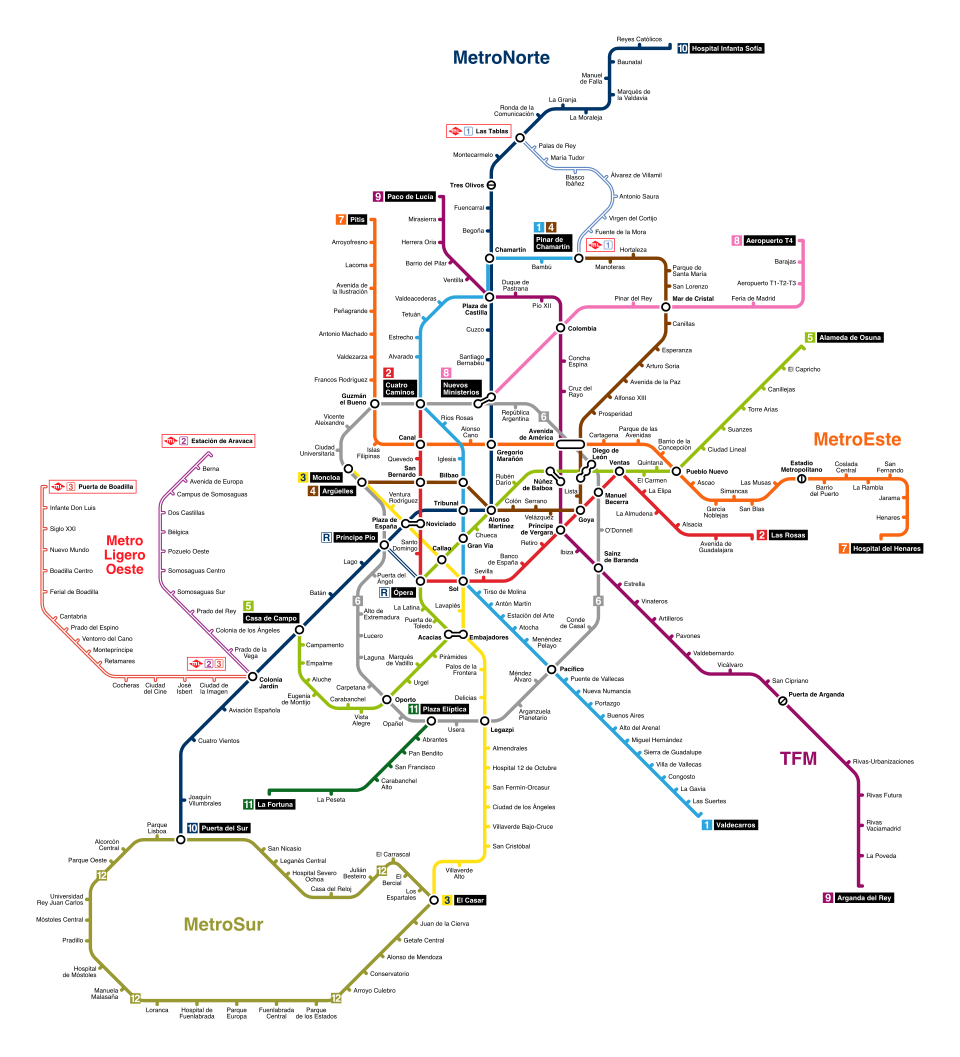
The full Metro de Madrid network. Map: Javitomad, CC BY-SA 4.0, via Wikimedia Commons.
Madrid doesn't have one citywide fare. It's split into zones — concentric rings radiating out from the center, not neighborhoods. Zone A is the city itself, which covers almost everything a first-time visitor sees. B1, B2, and B3 ring outward through the suburbs, then C1, C2, E1, and E2 reach further still, out toward Guadalajara and Toledo. What you pay depends on how many zones your trip crosses, and plenty of visitors don't know which zone they're even standing in.
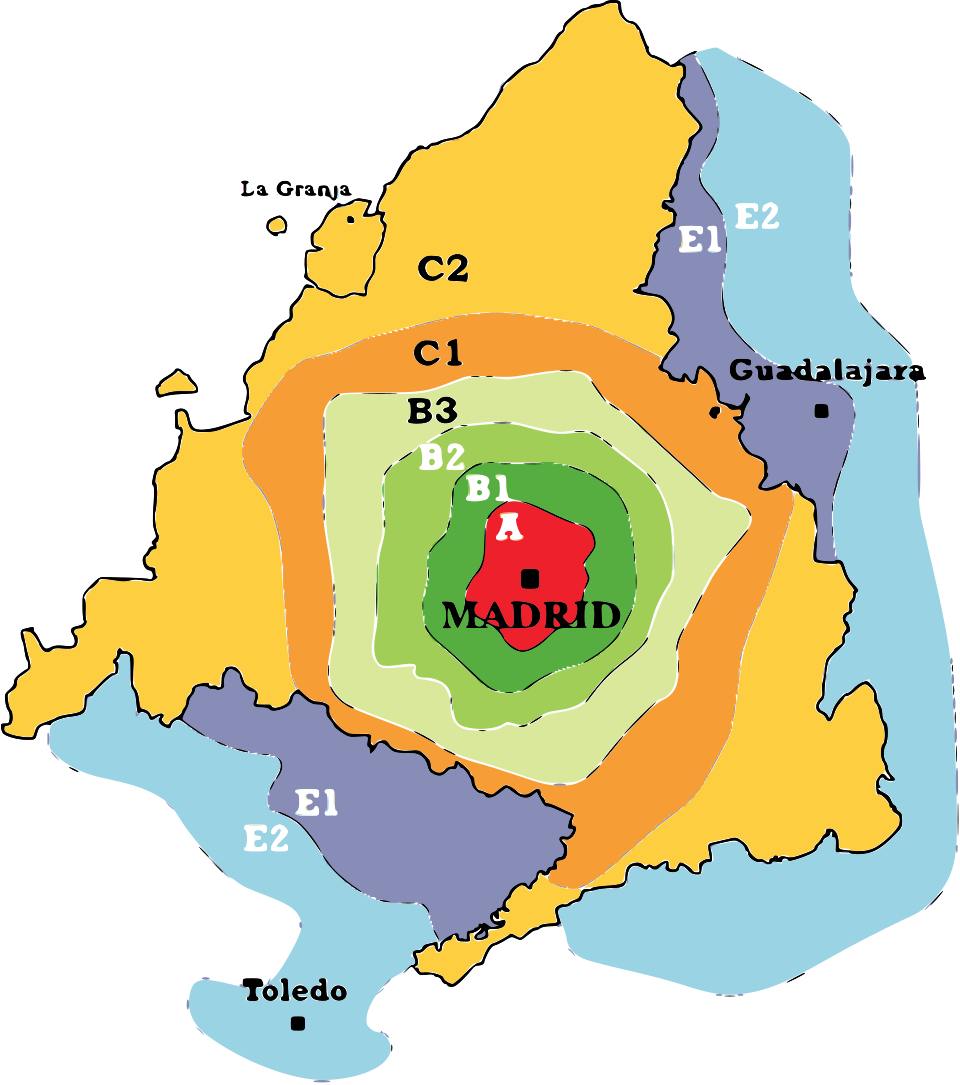
The real Comunidad de Madrid fare-zone map: Zone A (red) is the city itself, then B1, B2, B3, C1, C2 ring outward, with E1/E2 reaching as far as Guadalajara and Toledo. Public domain, via Wikimedia Commons.
Line 12, MetroSur, is the clearest example: a circular line that never touches central Madrid at all, connecting satellite cities like Getafe and Leganés to each other and back into the main network. In 2025, Line 3 was extended to El Casar station, which links onward to Line 10 toward Moncloa and Sol in the city center — the first expansion the network had seen in a decade.
Four networks, not one
The map above is only Metro de Madrid. Three more systems overlap it, and route-planning apps will happily string all four together into one journey without ever telling you that you've switched networks:
- Metro de Madrid — the underground network this whole article is about, run by the regional government.
- Cercanías — Renfe-operated regional trains, a completely separate company, used for trips just outside the city (El Escorial, Aranjuez, Alcalá de Henares) via ten lines meeting at Atocha, Chamartín, Nuevos Ministerios, Recoletos, and Sol.
- Metro Ligero — light rail/tram lines (ML1, ML2, ML3), mostly serving the northwest suburbs.
- EMT city buses — the odd one out. Buses take the same Tarjeta Multi as everything else, but you can also tap a contactless bank card directly on board for a single fare. That's mainly useful if you land and want to ride before you've bought a card, locals just use their Multi like everyone else.
One regional authority, CRTM, oversees all of it, and one physical card (more on that next) can hold tickets for metro, Cercanías, and Metro Ligero together. Buses are the exception, you pay for those separately, on board. A ticket for one network still won't get you onto another.
The ticket paradox
Paper tickets are gone in Madrid. Everything loads onto one reusable card, the Tarjeta Multi (€2.50, good for ten years). The confusing part is what you load onto it, several products, priced very differently:
- Single ticket: one ride, priced by zones/distance.
- 10-trip bundle: ten rides paid for upfront, at a real per-ride discount (two versions exist, see below).
- Tourist Travel Pass: a separate product entirely, unlimited rides for a fixed number of days (1-7), aimed at short visits rather than per-trip savings.
Buying single tickets one at a time is the expensive way to do this, the moment you're taking more than a couple of rides, a 10-trip bundle is cheaper per ride, and it's the same card either way. Get the zone right before you buy: if you're leaving the city center at all, MetroSur, day trips, the airport, you want the multi-zone bundle, not the Zone-A-only one. And here's the real gotcha: once a Tourist Travel Pass is loaded onto a card, nothing else can go on that same card until the Pass runs out. Decide which of the three products fits your trip before you load anything, not halfway through.
The English-language gap
Most ticket machines switch to English with one menu tap, and the whole purchase flow works fine in English. There's also a NaviLens voice-guidance system worth knowing about, built originally for blind and cognitively disabled riders, it doubles as real-time audio navigation for anyone who can't read Spanish signage fast enough. The harder part is people: station staff will help, but very few speak English fluently, so anything beyond pointing at a map can take a while. They'll usually get you sorted anyway. Just bring some patience if you need an actual conversation instead of a machine transaction.
The layer nobody warns you about: planned works
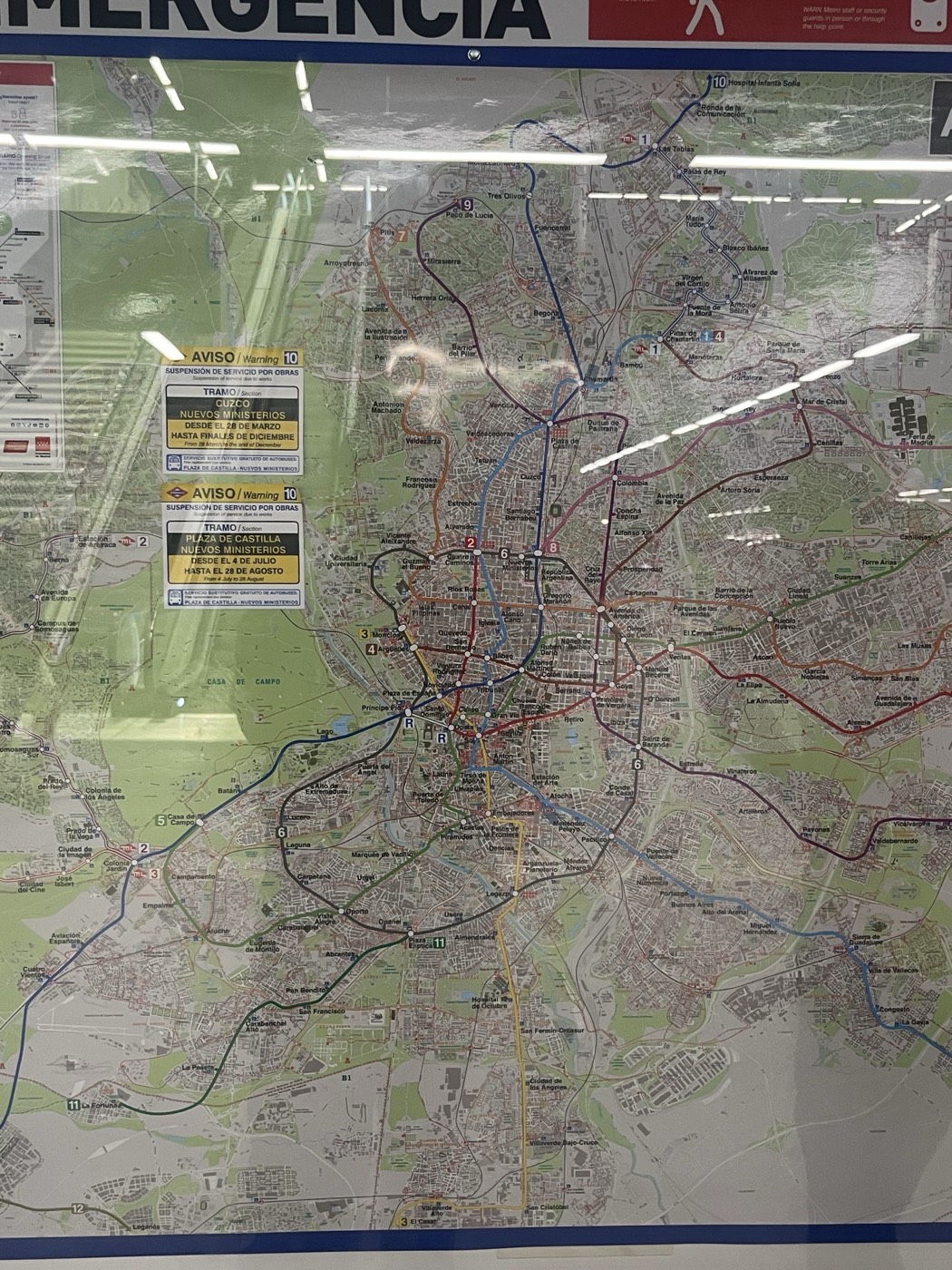
A real notice board photographed at a Madrid metro station, listing two separate Line 10 section closures for engineering works.
Entire line sections shut down for months at a time for planned works, with a free replacement bus running instead, and it's easy to walk straight into one without knowing. Right now: Line 10 is suspended between Nuevos Ministerios and Cuzco, from 28 March until the end of 2026, while Santiago Bernabéu station gets more than doubled in size (4,843 to over 12,400 square metres) with 12 new lifts and 24 new escalators. The replacement bus, the S10, runs every 2-3 minutes during peak hours.
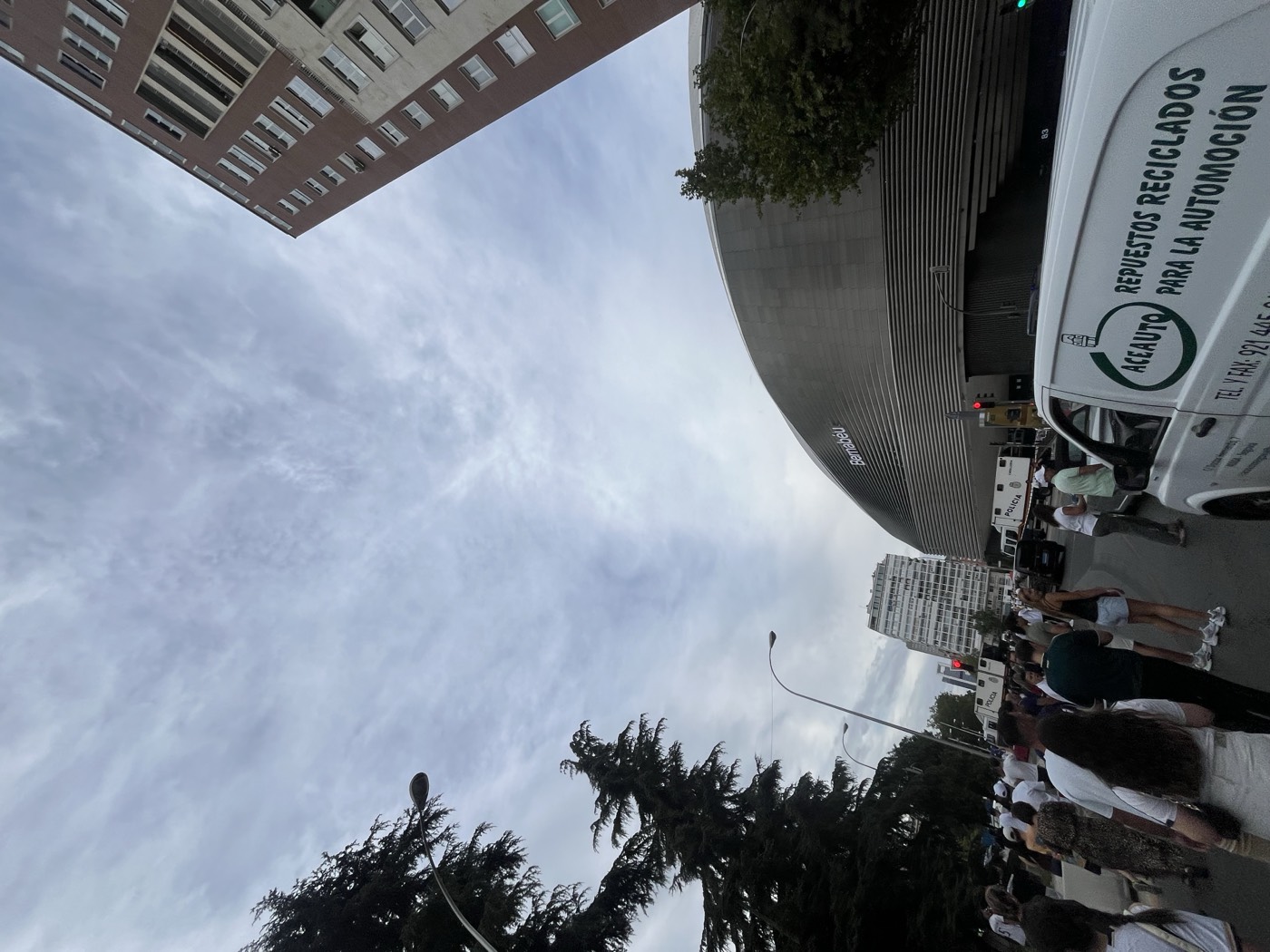
Santiago Bernabéu, seen from street level.
If you're headed there specifically, get off at Nuevos Ministerios and walk the rest of the way. It's one stop over on Line 10, a 10-12 minute walk, and honestly better than waiting for the bus, that stretch cuts through AZCA, Madrid's skyscraper district, tall towers the whole way instead of a bus window.
The actual fix, as a tourist
My honest take: I wouldn't spend more than five minutes on this before you land. Buy the card at your first station and get on with your day. Everything about zones and networks earlier in this article is real and worth knowing, just not on your first morning in the city.
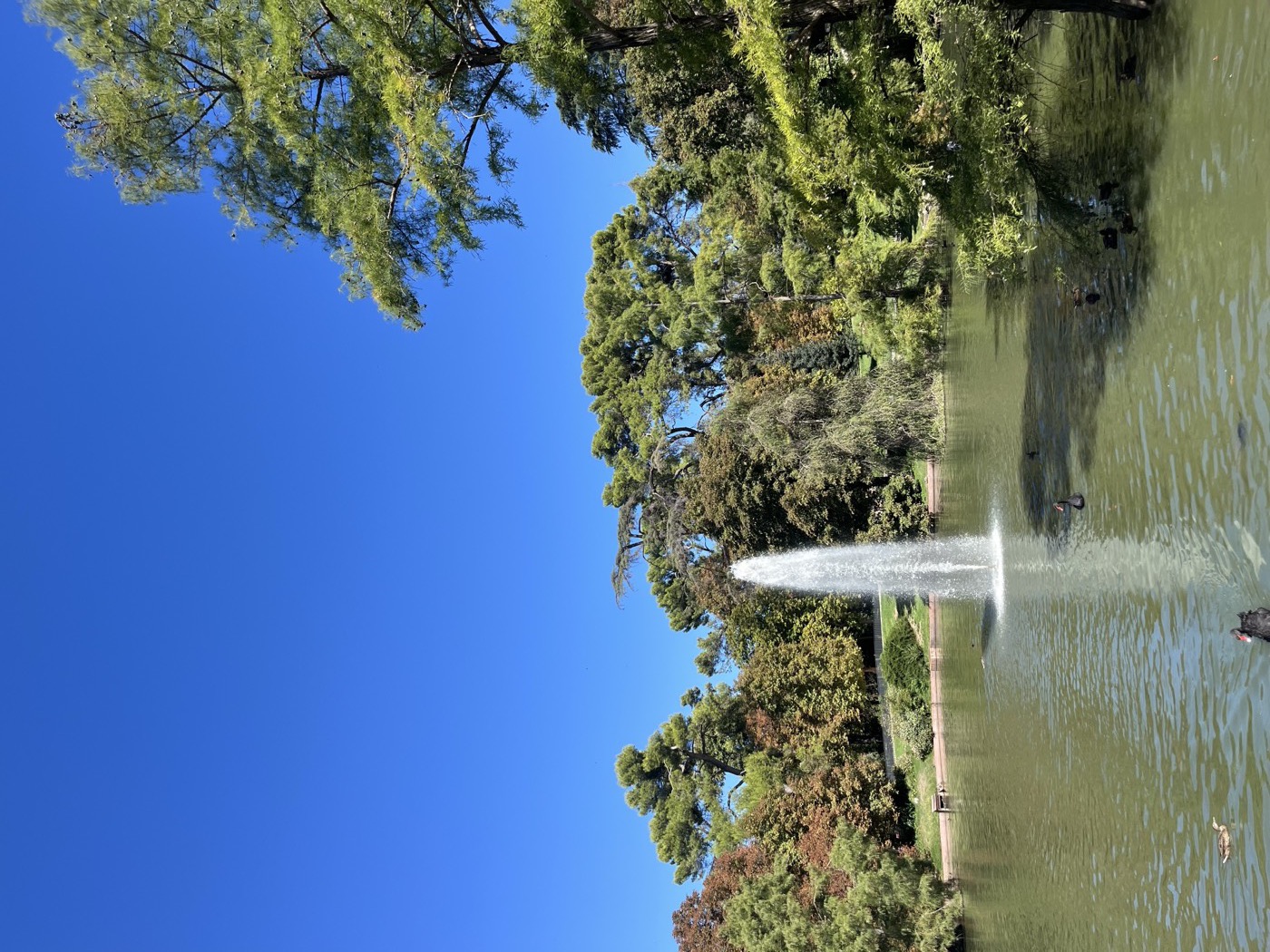
El Retiro's lake, one stop from Sol on Line 2, covered by the same multi-zone card.
Here's what to actually buy: one Tarjeta Multi, loaded with the multi-zone 10-trip bundle, around €10.90, not the cheaper Zone-A-only version. That one card covers most of what a visitor actually wants to see, El Retiro, Casa de Campo, Santiago Bernabéu, Plaza de España, even out to Leganés on the MetroSur loop (Parquesur, among other things). Ten rides is several full days of normal sightseeing for most people.
If you end up staying much longer than a normal visit, there's a better deal, but only for actual residents: a monthly Abono de Transporte for Zone A, around €32.70 with the standard 26-64 discount (full price is closer to €54.60), for unlimited travel across Metro, Cercanías, and Metro Ligero. As of June 2026 the discount legally requires proof of Madrid residency, empadronamiento, not just a passport, so this isn't a "stay a few weeks and grab it" option anymore.
More travel writing like this:
Browse the full blog →Sources
- Network size & history — Wikipedia's Madrid Metro article, citing Metro de Madrid and Comunidad de Madrid official data (579 lifts, 1,709 escalators, 70%+ station accessibility as of February 2026; 715 million riders in 2024).
- Fares & tickets — CRTM (Consorcio Regional de Transportes de Madrid) and Metro de Madrid's official fares page. The multi-zone 10-trip bundle price is a commonly cited figure rather than one pulled directly from a CRTM table, since their published tables don't cleanly separate every zone-coverage variant — worth confirming against the current machine price.
- Zones & routing — zone structure and MetroSur/Line 12 routing confirmed against Metro de Madrid's official line pages.
- Bernabéu / Line 10 — Metro de Madrid's official press releases (December 2023, March 2026, June 2026) and corroborating local reporting.
- Accessibility — Metro de Madrid's official accessibility page and independent rider reviews (English-language signage, NaviLens voice guidance).
- Resident pass & empadronamiento — Comunidad de Madrid's 2026 transport fare announcement (Abono Zone A pricing); the June 2026 residency-registration requirement reported by Moncloa.com, Libertad Digital, and Estrella Digital.
- Maps — the zone map is "Zonas Abono Transportes Madrid.svg" by Benedicto16/PatriaDeTodos (public domain); the network map is "Madrid Metro Map.svg" by Javitomad (CC BY-SA 4.0). Both via Wikimedia Commons.
- Photos — the station disruption notice board, Santiago Bernabéu exterior, and El Retiro park photos were taken in Madrid.
Questions or feedback?
I lived in Madrid and I'm happy to help if you have a specific question, or let me know if something here is wrong or out of date.